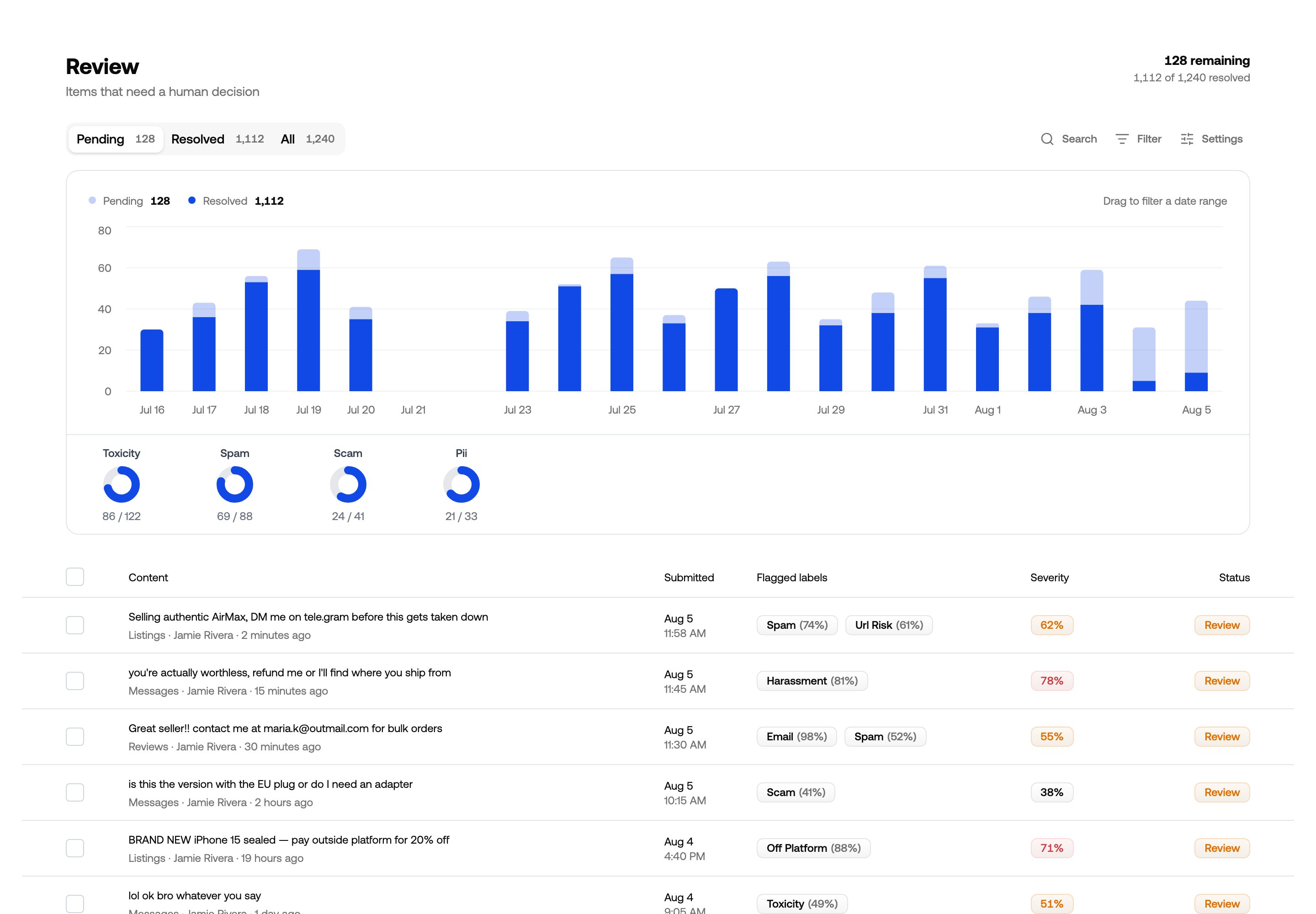
The tabs switch what the list shows. Pending is the work; Resolved is what’s
already been decided, where you can unresolve an item to look at it again; All is
both. Everything else on the page — chart, counts, filters — follows the tab.
Each bar is what arrived in that period, split into resolved and still-pending. Click
either series in the legend to hide it.Drag across the chart to narrow the list to that range — useful when you spot a spike
and want to know what caused it. The range becomes a date chip in the filter bar, so you
can adjust or remove it like any other filter.Underneath, each label shows how much of it is still open. Clicking a label filters the
list to it — a fast way to see what’s actually driving the backlog.
Click the checkmark to resolve it without opening it.
Tick several rows to act on them together.
Selecting items brings up an action bar with your actions,
Resolve, and Edit labels for correcting labels across the whole selection. On
the Resolved tab the button flips to Unresolve, so a batch resolved too eagerly
comes back in one step.
Selected items can be resolved or actioned in bulk
Which columns appear is a view setting, including
columns built from your own metadata.
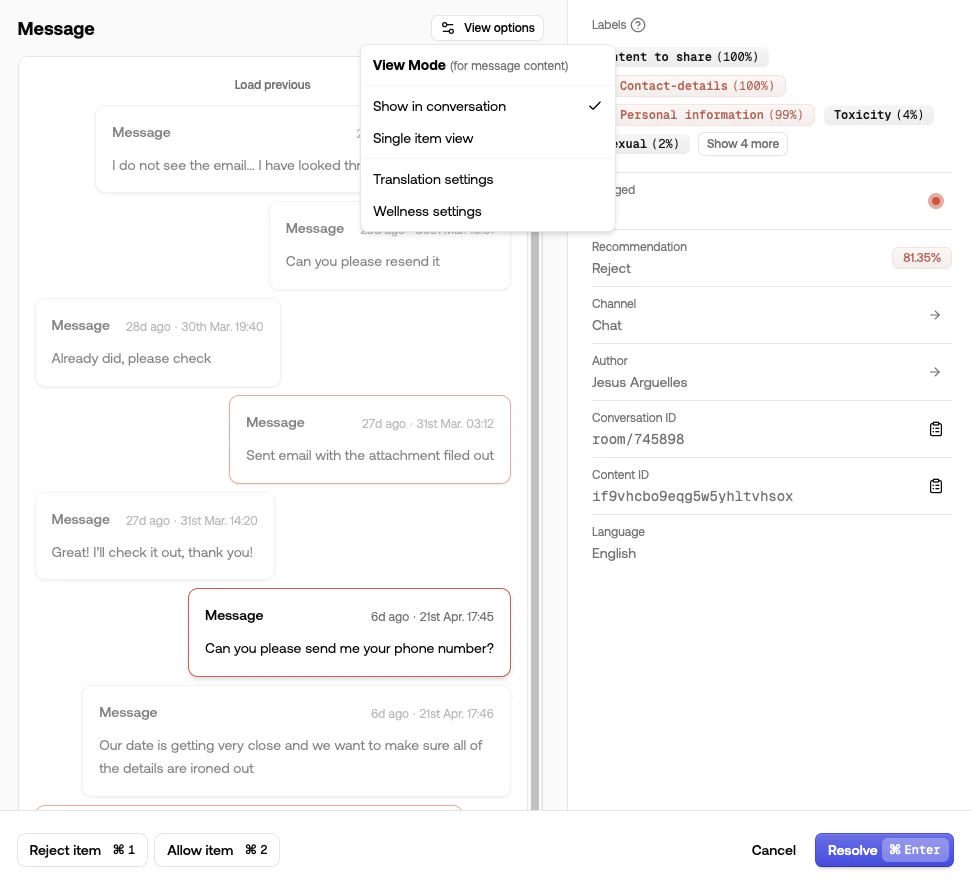
The detail panel shows the content itself, the labels that applied and why the item
was flagged, the metadata you submitted, the item’s history, and — where relevant —
the rule or threshold that produced the outcome. A Casebook tab at the panel’s
right edge shows how your
casebook would rule on the item,
with the closest past cases.
Content submitted as HTML renders in full, images and video included. Metadata that
looks like a URL becomes a link back into your own system.
If you submit a conversationId, the surrounding messages from that thread appear
inline, so you can read a remark in the exchange it belongs to instead of on its own.
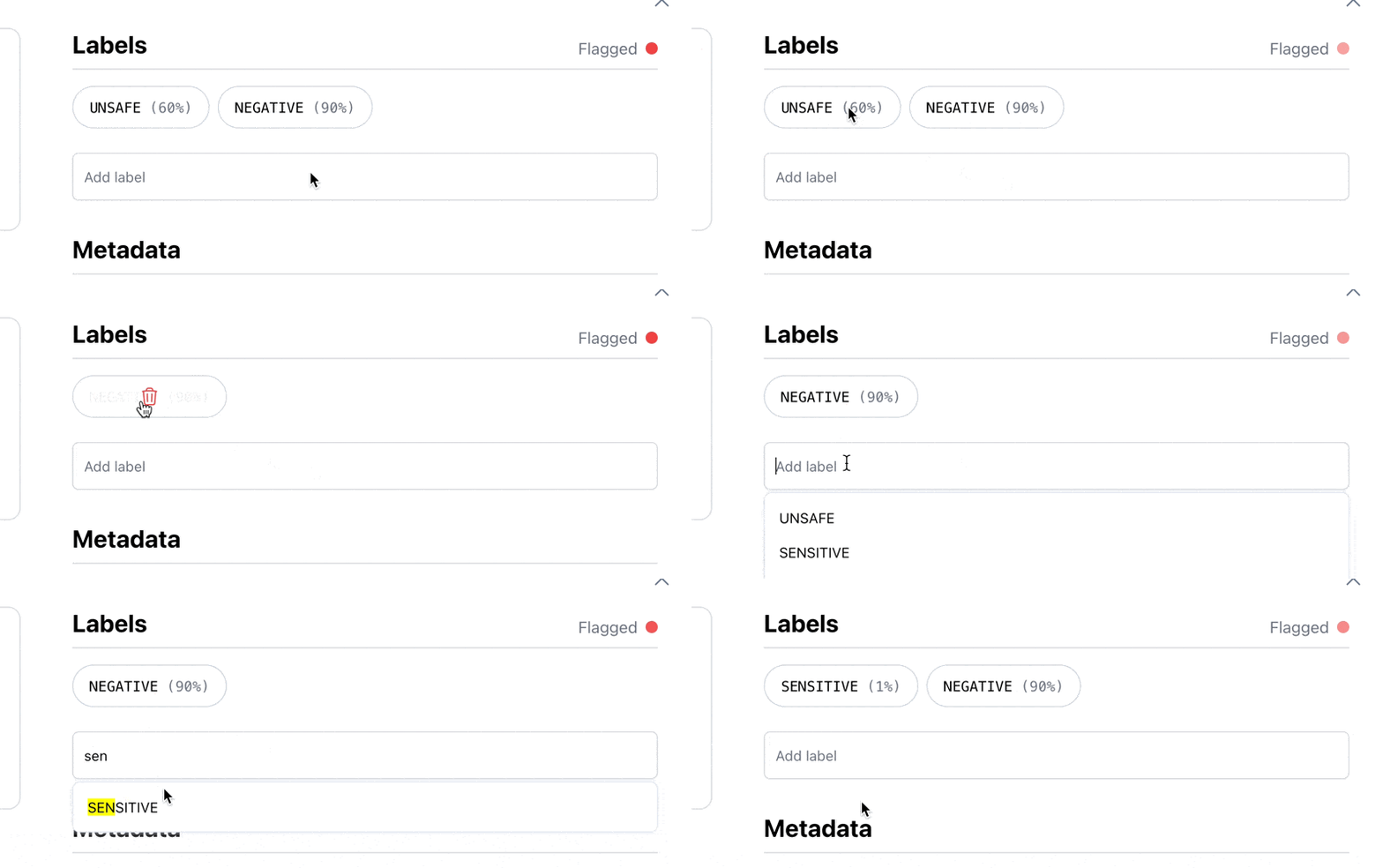
If a label is wrong, remove it and add the right one. Clearing every label means the
content warranted no flag at all.Corrections are kept and used the next time you run
adaptive optimization, so the policies
drift toward your judgement rather than away from it.
Images and video can be blurred, greyscaled or started muted. Each moderator sets
their own preference, and you can set a default for the project — see
Reviewer wellness.
Run an action or resolve from the detail panel, and it moves to the next pending item.
On an item that’s already resolved, the button reads Undo resolve instead.
Cmd + Enter resolves, Cmd + 1–9
runs an action, and the arrow keys move between items.
Resolving means the item has been dealt with; it moves to the Resolved tab. You can
resolve from the list, from the selection bar, from the detail panel, or automatically
as part of an
action.Whether resolving here also clears the item elsewhere depends on the view — see
items leave this view when.
The search box matches content text; each term becomes its own chip, and further terms
narrow the results. Filter also takes an author, a content ID or a conversation ID
when you need to pull up one specific thing — a content ID gives you every moderation
request for that item, which is what you want when a user appeals a decision. These
lookups are temporary and never saved into the view.
To investigate an author properly — their history, trust level and past actions —
open their author profile rather than filtering the list.