

Organization
The organization is the top-level container. It owns:- Billing and plan (quota, plan tier, invoices).
- Team members who can access the organization’s projects.
- Custom models, trained once and reusable across any channel in any project.
- Wordlists, managed in one place and enabled on the channels that need them.
Project
Projects scope your content and authors. Everything you submit to the API (content, authors, review, actions, and channels) belongs to a single project. Most teams use projects to separate environments like production and staging, or to keep distinct products apart. Each project has its own API key.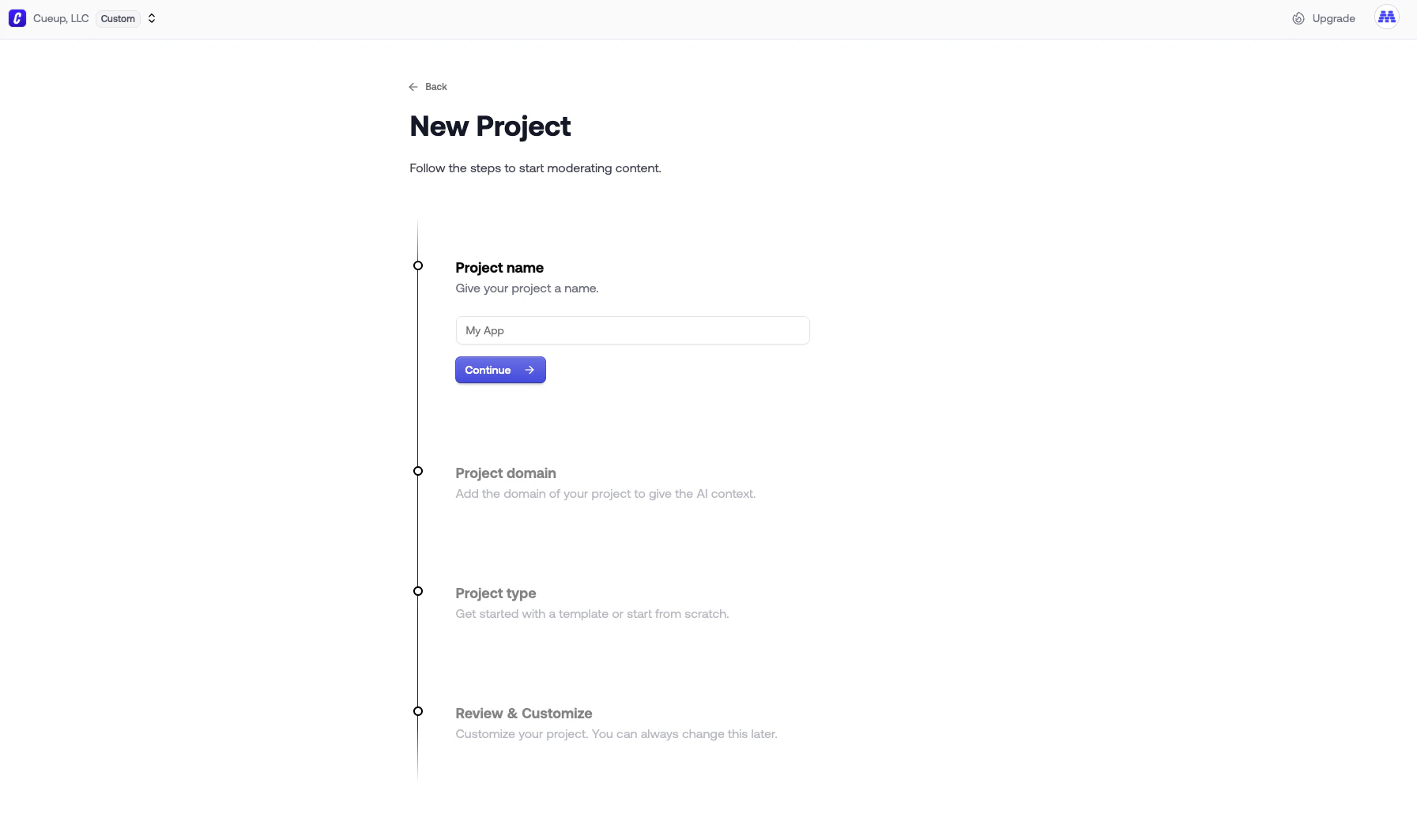
Creating a new project
- A name for the dashboard.
- A domain: the website or app this project moderates. The AI uses it as context, which sharpens the accuracy of LLM-based policies like Guidelines.
- A type: pick a template to preconfigure channels and content views, or start from scratch.
Templates create the channels and views. You decide which policies to enable on each channel.
Channel
Channels live inside a project and represent a specific surface or content type. Common examples arechat, reviews, listings, usernames, and profile-bio. Each channel is configured independently, so you can apply strict rules to user-to-user messages while keeping product listings looser.
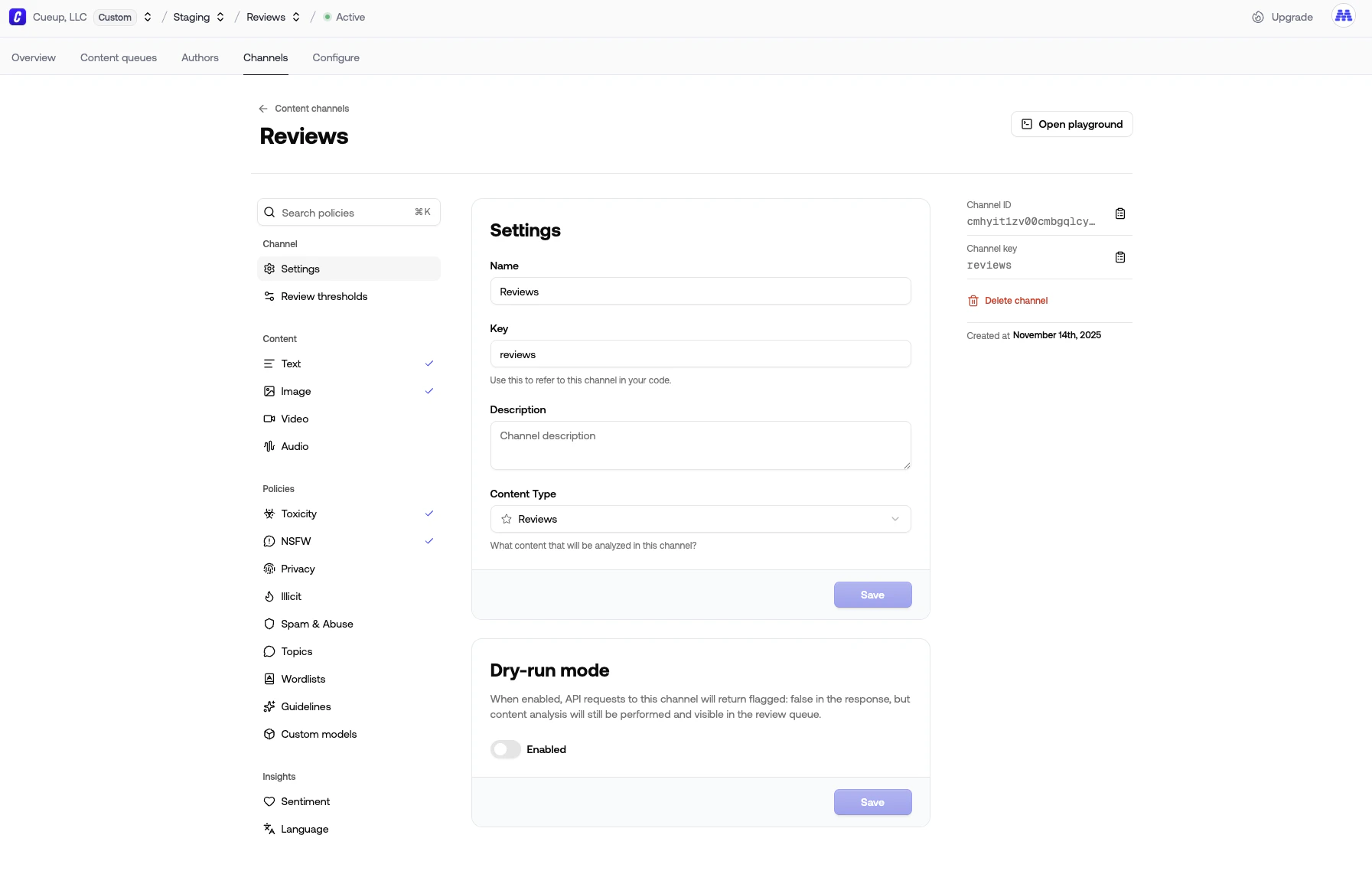
A channel and its settings
- Settings. Name, key (used to route requests, see below), description, and the content types it accepts (text, image, video, audio).
- Review thresholds. The cutoffs at which content gets flagged.
- Policies. The rules that score content. Toggle each one on or off per channel. See Policies for the full list.
- Insights. Opt-in signals like sentiment and language. They come back alongside policy results but don’t affect flagging.
- Dry-run mode. When on, API responses always return
flagged: falseso production traffic isn’t blocked, but content is still analyzed and still lands in review. Use it to preview a channel before going live.
Routing requests to a channel
You authenticate with a project’s API key. To pick which channel handles each request, the API checks, in order:- The
channelfield in the request body (see Submitting content). - A channel whose content type matches the request’s
metaType. For example,metaType: "review"routes to a channel configured for reviews. - Otherwise, the newest channel in the project.
Policies
A policy is a single rule that runs against submitted content. Each enabled policy returns one entry in the API response’spolicies array. Because policies are enabled per channel, the same project can run Toxicity on chat messages while only running Privacy on profile bios.
Policies fall into two types:
See the Policies overview for the full catalog.
A few pieces sit above the channel and get attached to it:
- Custom models are trained at the organization level and can be enabled on any channel.
- Wordlists are also organization-level, then enabled per channel.
- Guidelines are written per channel, since the rules usually depend on the surface.
Authors
Authors (your end users) are scoped to the project, not the channel. A single author can post into multiple channels. For example, the same user might send chat messages, write reviews, and update their profile bio. The author’s trust level and moderation history aggregate across every channel in the project.Review and content views
Most content is handled automatically; what needs a person goes to review. The inbox collects those items across all channels. Content views are saved, filtered slices of your content — by channel, label, severity, or the action that was taken — and aren’t limited to what the inbox holds, so a view can also cover content that was auto-rejected. Views are project-scoped, and a project can have as many as it has distinct reviewer workflows. Decisions made in review are remembered by the project’s casebook, which settles similar content automatically the next time it arrives.Quota
Quota is shared across the organization. Each request to the/moderate endpoint consumes quota. Most requests cost one unit, though some content types and policies cost more. See Quota & usage for the per-policy cost table.