> ## Documentation Index
> Fetch the complete documentation index at: https://docs.moderationapi.com/llms.txt
> Use this file to discover all available pages before exploring further.
# Wordlist monitoring
> Watch terms you've deliberately chosen not to flag
## The problem
Some terms you want to know about but not act on. A competitor's name in a review isn't
a violation. Neither is a customer promising a refund, or a mention of a product you've
had trouble with. You want visibility, not enforcement — and flagging them would bury
your moderators in content that needs no decision.
## The view
A [wordlist](/policies/wordlists) in **Pass** mode matches content and records the
hits without ever flagging it.
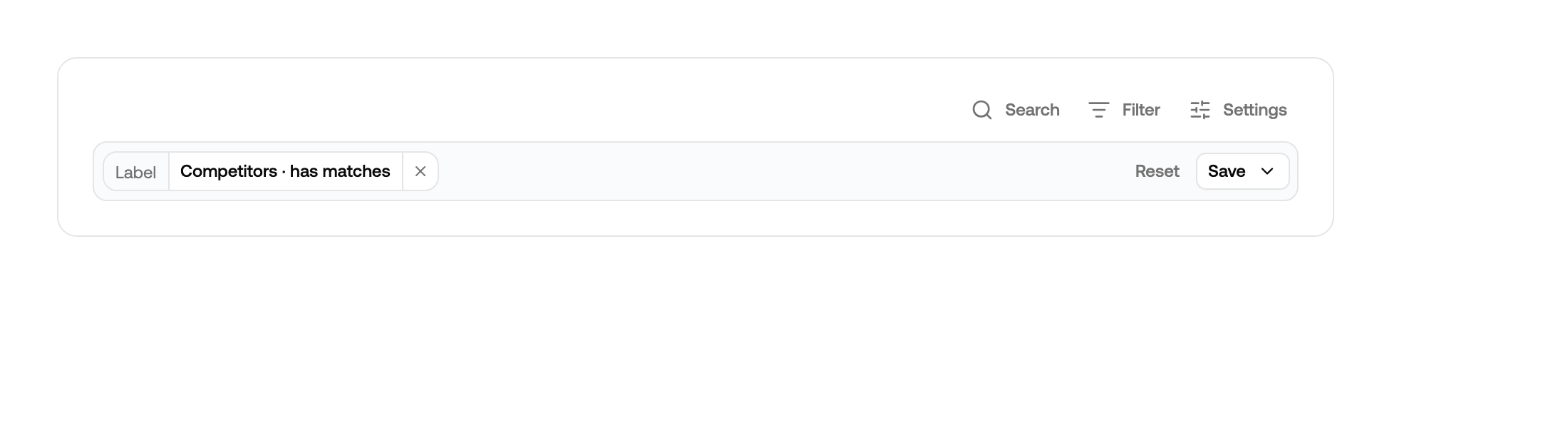
Filter **Label →** your wordlist **→ Has matches**.
 ## Why not "Flagged"
**Flagged** asks *did this label flag the content* — and a wordlist in Pass mode never
does, so the view would be permanently empty. **Has matches** asks the broader
question: *did this label find anything at all*, flagged or not. It's the only rule
that finds content a policy noticed and deliberately let through.
For classifiers, which return a confidence rather than concrete matches, the same rule
is named **Detected**.
This view is a monitoring surface, not a work queue. Set **Ordering → Newest first**
and skim it — there's nothing here that has to be resolved.
## Why not "Flagged"
**Flagged** asks *did this label flag the content* — and a wordlist in Pass mode never
does, so the view would be permanently empty. **Has matches** asks the broader
question: *did this label find anything at all*, flagged or not. It's the only rule
that finds content a policy noticed and deliberately let through.
For classifiers, which return a confidence rather than concrete matches, the same rule
is named **Detected**.
This view is a monitoring surface, not a work queue. Set **Ordering → Newest first**
and skim it — there's nothing here that has to be resolved.