> ## Documentation Index
> Fetch the complete documentation index at: https://docs.moderationapi.com/llms.txt
> Use this file to discover all available pages before exploring further.
# Casebook
> The casebook remembers your team's review decisions and settles similar content automatically
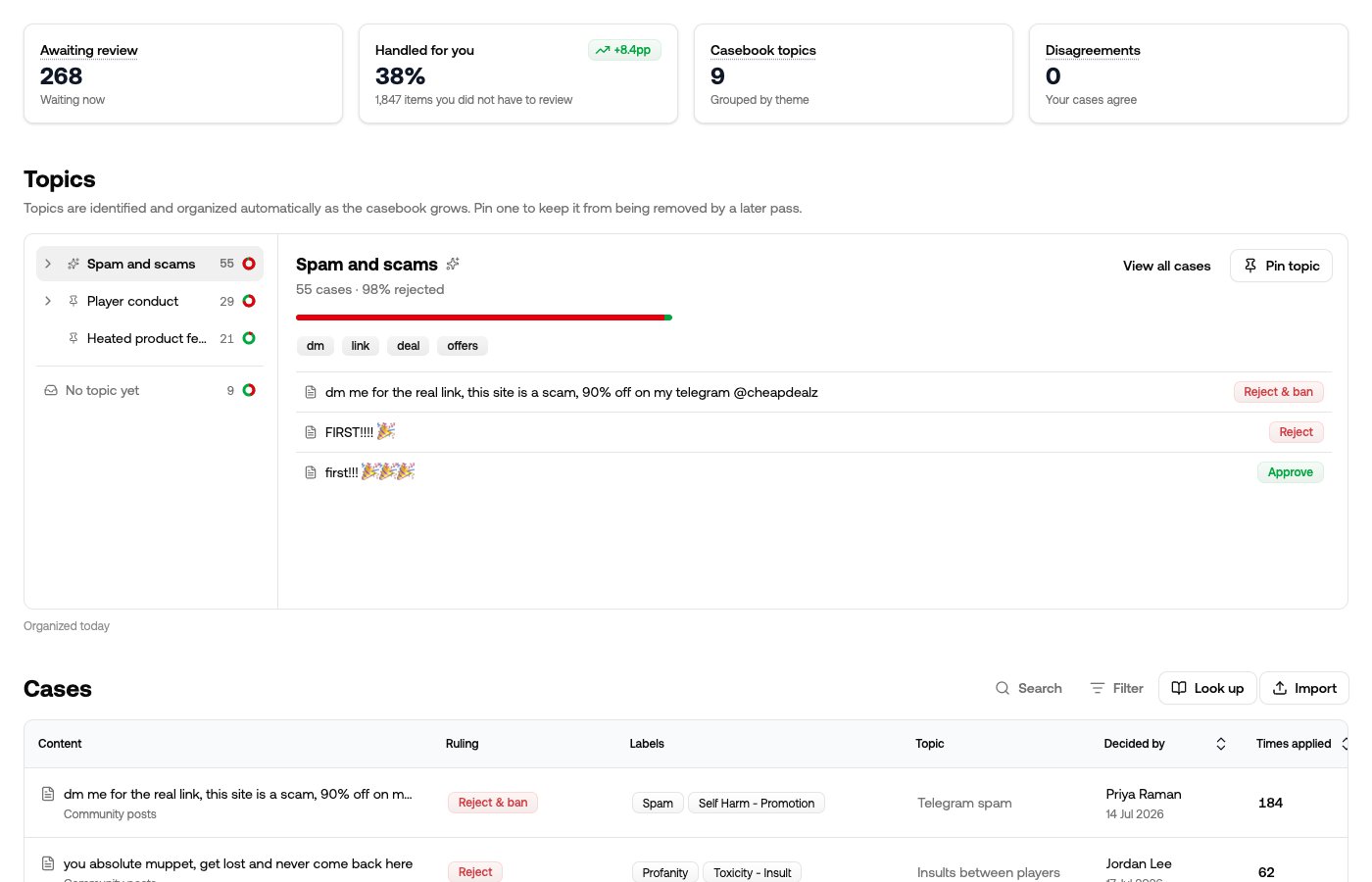 Review teams decide the same things over and over. A rejected scam template, an
approved profile update, a corrected resubmission — each comes back with small edits
and gets reviewed again from scratch.
The casebook is your project's memory of review decisions. Every human allow or
reject in [review](/review/overview) is remembered as a **case**, and when new
content arrives that reads like something your team already decided, the casebook
applies the same ruling — so nobody reviews it again.
## How cases are created
Every human **Allow** or **Reject** in the review inbox becomes a case
automatically. An action that neither allows nor rejects is not added, and only
humans set precedent: automated decisions and author actions like block or warn
don't become cases.
When a [lookup](/casebook/rulings#test-your-casebook) finds nothing, **Add this
as a case** lets you teach a decision directly — paste the content, choose Allow
or Reject. Similar content follows from then on.
Seed a new casebook from the last 90 days of your review history, or upload a
CSV of content and rulings from another tool. See
[importing cases](/casebook/managing#importing-cases).
## What a case holds
Review teams decide the same things over and over. A rejected scam template, an
approved profile update, a corrected resubmission — each comes back with small edits
and gets reviewed again from scratch.
The casebook is your project's memory of review decisions. Every human allow or
reject in [review](/review/overview) is remembered as a **case**, and when new
content arrives that reads like something your team already decided, the casebook
applies the same ruling — so nobody reviews it again.
## How cases are created
Every human **Allow** or **Reject** in the review inbox becomes a case
automatically. An action that neither allows nor rejects is not added, and only
humans set precedent: automated decisions and author actions like block or warn
don't become cases.
When a [lookup](/casebook/rulings#test-your-casebook) finds nothing, **Add this
as a case** lets you teach a decision directly — paste the content, choose Allow
or Reject. Similar content follows from then on.
Seed a new casebook from the last 90 days of your review history, or upload a
CSV of content and rulings from another tool. See
[importing cases](/casebook/managing#importing-cases).
## What a case holds
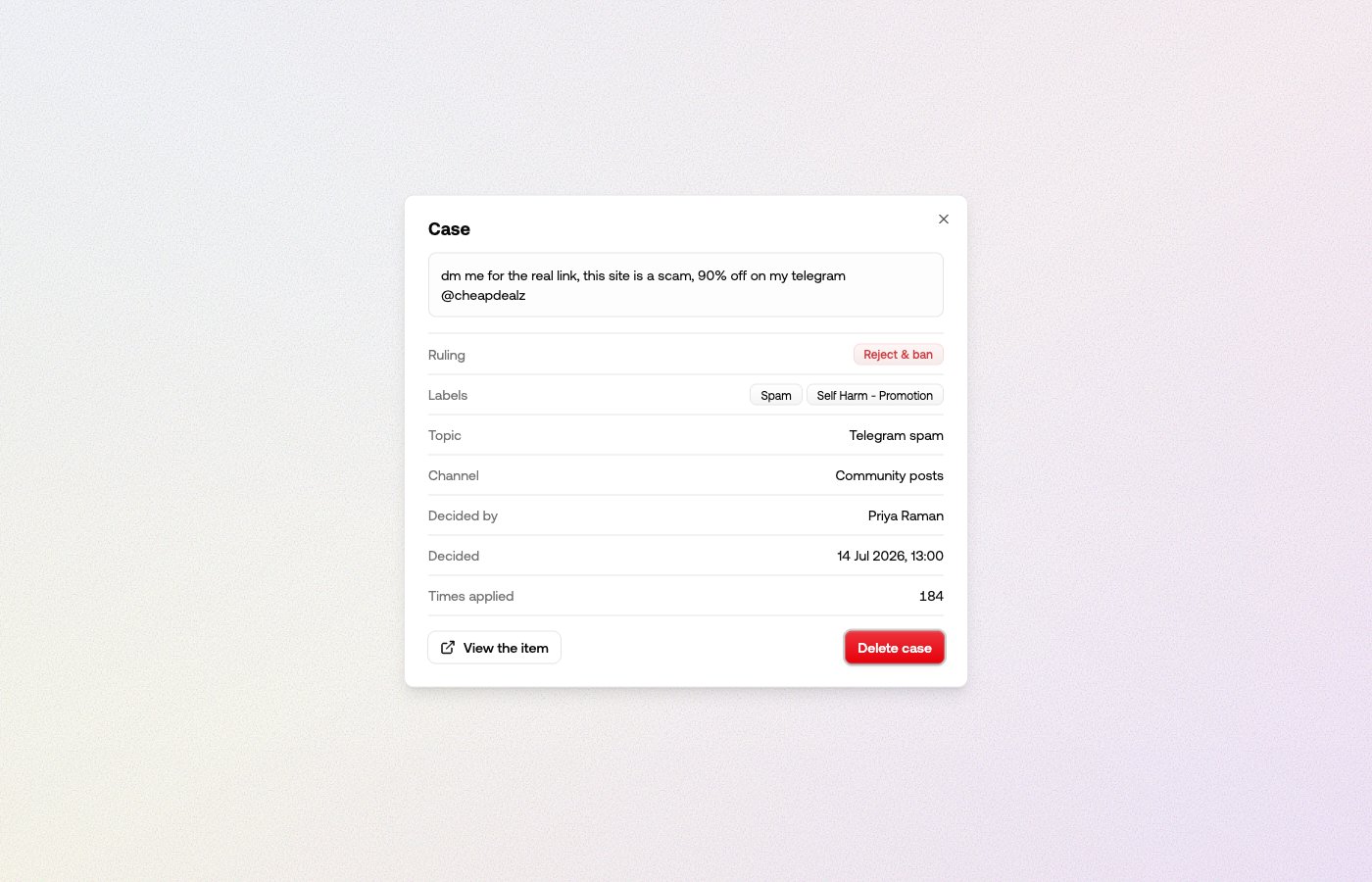 A case is a snapshot of one decision: the content, the **ruling** — always allow or
reject — the **labels** your policies flagged at the time, the channel, who decided
it and when, and **times applied** — how many later items this case has settled. From
the case you can open the original item it was decided on.
A new case spends a short moment being committed to memory before it can match
content — the ledger marks these and tells you how many are left.
## How to enable
The casebook is on by default: new projects remember review decisions, and new
channels start with the casebook rule enabled. Two settings control it:
* **Configure → Casebook** turns the casebook on or off for the whole project. Off
means nothing is remembered and no lookups run.
* The **Casebook lookup** rule in each channel's [rules](/content-moderation/rules)
decides whether the casebook may settle content on that channel. Turn it off where
you want the casebook to watch and learn but not decide.
Applying rulings is available on the Growth plan and above. Remembering works on
every plan, so your casebook keeps learning in the meantime and the rule works the
moment you upgrade.
## Reading the stats
The four cards at the top of the Casebook page:
* **Awaiting review** — what's sitting in your review queue right now.
* **Handled for you** — the share of would-be reviews the casebook settled instead,
with the item count. Press it to open those items in the queue. While no channel
enforces, it reads **Casebook could have handled** — the reviews you'd have been
spared.
* **Casebook topics** — how many [topics](/casebook/topics) your cases are grouped
into.
* **Disagreements** — cases that rule opposite ways on similar content. Until someone
[resolves them](/casebook/managing#disagreements), the casebook applies neither
ruling to content like theirs.
## Where to go next
* [How the casebook rules](/casebook/rulings) — when it decides, when it deliberately
declines, and how to test it.
* [Topics](/casebook/topics) — how the casebook organizes what it remembers, and
rules that act on a whole topic.
* [Managing your casebook](/casebook/managing) — imports, disagreements, and making
the casebook forget a decision.
A case is a snapshot of one decision: the content, the **ruling** — always allow or
reject — the **labels** your policies flagged at the time, the channel, who decided
it and when, and **times applied** — how many later items this case has settled. From
the case you can open the original item it was decided on.
A new case spends a short moment being committed to memory before it can match
content — the ledger marks these and tells you how many are left.
## How to enable
The casebook is on by default: new projects remember review decisions, and new
channels start with the casebook rule enabled. Two settings control it:
* **Configure → Casebook** turns the casebook on or off for the whole project. Off
means nothing is remembered and no lookups run.
* The **Casebook lookup** rule in each channel's [rules](/content-moderation/rules)
decides whether the casebook may settle content on that channel. Turn it off where
you want the casebook to watch and learn but not decide.
Applying rulings is available on the Growth plan and above. Remembering works on
every plan, so your casebook keeps learning in the meantime and the rule works the
moment you upgrade.
## Reading the stats
The four cards at the top of the Casebook page:
* **Awaiting review** — what's sitting in your review queue right now.
* **Handled for you** — the share of would-be reviews the casebook settled instead,
with the item count. Press it to open those items in the queue. While no channel
enforces, it reads **Casebook could have handled** — the reviews you'd have been
spared.
* **Casebook topics** — how many [topics](/casebook/topics) your cases are grouped
into.
* **Disagreements** — cases that rule opposite ways on similar content. Until someone
[resolves them](/casebook/managing#disagreements), the casebook applies neither
ruling to content like theirs.
## Where to go next
* [How the casebook rules](/casebook/rulings) — when it decides, when it deliberately
declines, and how to test it.
* [Topics](/casebook/topics) — how the casebook organizes what it remembers, and
rules that act on a whole topic.
* [Managing your casebook](/casebook/managing) — imports, disagreements, and making
the casebook forget a decision.